New and Notable from Special Collections and University Archives:

New Acquisitions, Events, and Highlights from Our Collections

August 27, 2010

Welcome Back SDSU!

Fall 2010 Greetings to returning students, faculty and staff at San Diego State! Special Collections and University Archives is gearing up for a fantastic semester, full of class visits, exhibit openings, and extended public service hours.

This fall, you can browse several terrific exhibits in the library which
feature materials from Special Collections. In the Donor Hall, see original newspapers, photographs, correspondence, and other primary sources drawn from our Women's Studies collections in "Sustaining a Revolution: Women's Studies Turns 40." In Special Collections (on the fourth floor of the Library Addition), you can view first editions, rare ephemera, and manuscripts in our visiting exhibit from Vanderbilt University, "Mark Twain: An American Original," as part of our year-long celebration of Twain. Outside the department in our foyer gallery, see items from the collections supporting the legacy of Mark Twain in "Laughing Matters: Researching American Humor in Special Collections." Last but definitely not least on the exhibit schedule, we will be opening our fantastic exhibit on Chicano/a history in San Diego, called "Unidos por la Causa: The Chicano Experience in San Diego," on October 1st in the Reference area. Come check them out while you're under the Dome! If you miss them during the library's open hours, we'll have online versions of most of these exhibits later in the fall.

This year, we're happy to return to our extended service hours in the Reading Room. We'll be open for you to consult
the collections Mondays and Tuesdays 10am to 7pm, and Wednesdays through Fridays 10am to 5pm, so drop by any time! And if you want to browse our holdings after those hours, check out our research guides or our Finding Aid Database. Got a question? Browse our homepage, send us a reference question, check out our digital collections, or better yet, drop by the department to get an extended reference consultation with one of our librarians!

Images: Registration, 1965: University Archives Photograph Collection.

July 20, 2010

A New Astronomical Acquisition

This spring, Special Collections acquired a very special book for our Historic Astronomy Collection. First published in 1524, Cosmographia was written by Peter Apian (or Petrus Apianus in the more common Latin version of his name), and was such a popular text that it eventually went through 45 separate editions. In Cosmographia, Apianus gave for lay readers an introduction to the discipline of cosmography, which blended concepts in astronomy, astrology, navigation, cartography, geography, and instrument design in order to plot the positions of astronomical and terrestrial masses (such as stars, planets, or continents).


A few years after the first edition appeared, mathematician Gemma Frisius published an edited version of Cosmographia and added his own corrections and additions to Apianus' original text. Special Collections' new acquisition is Frisius' version of 1540. Frisius added many illustrations to the text, as well as complex volvelles (stacks of paper discs strung together on a page and rotated to compute calculations in geographical, astronomical, or mathematical problems). In our 1540 version there are four complete working volvelles, which helped the reader determine calculations about distance, altitude, and even time of day. The volvelles are supplemented by many striking woodcuts.


Apianus discussed many basic elements of cosmography in his work, illustrating them so that a beginners in the field could easily understand. Here, he plays with a visual analogy: geography is similar to drawing the whole head; chorography (or topography) is similiar to looking closely at the detail of an eye or ear. Apianus introduces several practical ways to measure distance, such as these illustrating how to measure by using one's hands or by paces.


Our copy of this fantastic work really has it all! It is bound in a vellum manuscript leaf with initials in blue and red. It also happens to be a copy formerly owned by Owen Gingerich, the famed historian of early astronomy who also wrote the introduction to our Catalogue of the Rare Astronomical Books in San Diego State University Library in 1988. The
1540 edition joins a 1537 edition in our Historic Astronomy Collection.

June 29, 2010

Happy Independence Day!

In honor of July 4th, the library and Special Collections will be closed all day on Monday, July 5th. But after the holiday, we'll resume our summer hours of 10am to 3pm, Monday through Friday. In July, look for a brand new online exhibit about the history of San Diego theatres, a new page of highlights from our Spring book arts exhibit, Above and Beyond, a new physical exhibit in the Donor Hall honoring the fortieth anniversary of Women's Studies at San Diego State, and a new exhibit in the Reading Room commemorating the 100th anniversary of the death of Mark Twain. Stay tuned for more details as we work on these projects through our busy summer!

Image from the John and Jane Adams Postcard Collection.

June 15, 2010

Two Final Spring Collections

To round out our list of Spring 2010 newly processed collections, we'll end with the fascinating archival collection of an important local organization, and the related manuscript collection of a notable San Diegan. Both collections add significantly to our strong emphasis on African-American history and general twentieth-century social history in San Diego, which also includes the Carlin Integration Case Records, Citizens United for Racial Equality Records, School Integration Task Force Records, and the Leon Williams Papers. Documents from both new collections now supplement our wonderful online exhibit, "Creating Community: African-Americans in San Diego."

Image: Protest against discriminatory employment practices at the San Diego Bank of America, 1964. From the Harold K. Brown Papers.


Center for Community Economic Development Records
, 1963-2006 (MS-0432)
Initially formed in 1995 as a certificate program in Community Economic Development at San Diego State University's College of Business Administration, the program expanded in 2000, becoming the Center for Community Economic Development (CCED) under the direction of Harold Brown. The Center's goal was to endorse economic self-reliance, and generate community-minded individuals in the hopes of improving disadvantaged and low-income neighborhoods. The collection documents the establishment, operation, and curriculum of the Center's thirteen-year existence. The collection includes correspondence, reports, power point presentations, student projects, photographs, certificates, awards, seminar handouts, class curricula, real estate research files, and student rosters. The majority of materials date from 1996 to 2005, and highlight the CCED's efforts to promote and foster community economic development through classes, seminars, and student projects.

Harold K. Brown Papers, 1956-2000 (MS-0436)
Hal Brown became extremely active in the San Diego civil rights movement during the 1960s. Later, Brown became the Deputy Director for the US Peace Corps in Lesotho. In 1971, he returned from Africa and became California State University's Assistant to the Vice President for Academic Affairs and Assistant to the Vice President for Administration, making him the first African-American administrator at San Diego State. Later, he was the Associate Dean of Planning and Director of the Afro-American Studies Program. The collection documents Brown's participation in the local Civil Rights Movement, his dedication to community economic development, and his professional life, with a heavy emphasis on the Congress of Racial Equality (CORE), Brown's role in the School Integration Task Force, and his involvement with the Black Economic Development Task Force.

June 9, 2010

Women's Studies turns 40


This summer in Special Collections, we're gearing up for our Fall 2010 exhibit honoring the fortieth anniversary of the Women's Studies program at San Diego State, which was the first Women's Studies program ever founded in the U.S. in 1970. Special Collections is collaborating with the department to research, mount, and install a fine display of our fascinating primary sources related to the historic founding of the program. Our friends at SDSU's 360 Magazine currently have an article featuring perspectives on the anniversary from the department chair, an alumnae, and newly-minted M.A. graduate, Stevie Seibert. In the interview produced by 360, Stevie talks about her extensive research on the exhibit and about her experiences researching in Special Collections. We're looking forward to a great exhibit in the fall!

June 3, 2010

Next Up: Some Intriguing Manuscripts

Next up in our parade of newly processed Spring collections are two fascinating manuscript pieces. The first is a lovely set of diaries from a young New York girl in the 1870s, and would be perfect source material for scholarship on the history of girlhood or childhood in the late 19th century, or on American recreation, tourism, or vacationing. It would also be a great resource for anyone studying early photography in Minnesota or in the upper Midwest.

The second collection is an exciting piece of California history, and is a vital resource for studying the settlement and development of California, the history of the Chinese in California, or post-Gold Rush transportation history. Check out these finding aids for more details!

Hattie French Diaries, 1874-1878 (MS-0435)
Hattie French was born in Buffalo, New York in 1859, and died 28 December 1923. Her parents were Edward French and Abigail Furman, and she had one sister, Abbie. This collection consists of two diaries kept by Hattie French on two separate family summer vacations. The first volume dates from July 9-August 13, 1874, and chronicles a beachside holiday on the Atlantic coast when Hattie is 15 years old. The second diary details Hattie's summer trip from July to September in 1878. This journey was undertaken "for her health." Hattie writes about a variety of travel adventures, including getting stranded briefly on a sandbank in the low Mississippi River, dancing with other passengers on the boat while entertained by African-American musicians, and seeing a number of attractions, such as the chapel at the Shattuck-St.Mary's School, and the local asylum for the deaf and dumb.

California Stage Company Register, 1864-1868 (MS-0443)
The California Stage Company was founded by James E. Birch and was one of the principal stagecoach lines carrying passengers during the California Gold Rush during the 1850s. The company became a Wells Fargo line later in that decade, carrying mail, money, and passengers, and by the early 1860s was operating a huge network of stage lines out of three main hubs: Sacramento, Folsom, and Marysville. The ledger begins on January 1, 1864 and ends on August 3, 1868, and is a log of the daily stagecoach run between North San Juan (the line stop where the book was based), Sacramento, Nevada (CA), and Virginia City (NV). Passenger names, residence, destination, fare paid, and cashier name are all detailed for each day; other details such as extra or special baggage, driver name, and special directions are also given.

May 25, 2010

Three Performing Arts Collections

Next up in our list of newly processed collections for the spring are three collections related to different areas of San Diego performing arts history. The Sellman Playscripts collection includes annotated scripts and stagings for what was presumably a local company of actors at the turn of the century. The Merle Clayton Papers include fascinating correspondence from a local actress of the "golden ages" of both San Diego theatre and Hollywood, as well as a number of photographs of Julian Eltinge, "the greatest female impersonator of the twentieth century." And the Records of JuleTone Productions includes wonderful materials documenting rehearsals, stage directions, musical compositions, participants, and venue preparation for a local musical theatre production company which specialized in providing entertainment for charities and private events. An online exhibit complementing the JuleTone collection is available here.


Hunton D. Sellman Playscripts Collection, 1900-1913 (MS-0414)
This collection is made up of ten manuscript playscripts and actors sides, from plays written between 1900 and 1913. Some are copyrighted and published by the Chicago Manuscript Company. The majority seem to have been produced by a theatrical company called "Gray, Dowell, and Company"; the names Julia Gray and Ed Dowell appear consistently as names of actors. Scripts and sides have manuscript notations and stage directions, presumably made by the actors; most side have the name of the actor to play the role pencilled on the front cover. These playscripts were donated by Hunton D. Sellman, a professor of Theatre and stage lighting designer at San Diego State until his retirement in 1971. It is not known whether Sellman had any personal involvement in the production of these plays.

Merle Clayton Papers, 1951-1976 (MS-0089)
This small collection consists primarily of research materials used by Merle Clayton, author of several local history pieces for San Diego Magazine. The materials consist of paper records, photographs, and several copies of San Diego Magazine. Clayton did a series of pieces on topics in the history of theatre and performing arts in San Diego, and most of this material pertains to that work. Of special note in Series I is the six-year correspondence between Clayton and actress Virginia Brissac, who he interviewed several times in person for a series of articles on her life. Brissac was famous in San Diego during the most active period in its performing arts theater; first with the Savoy Players and World's Fair Stock Company, then founding and managing the Virginia Brissac Company, a stock company which put on a play a week from about 1915 to 1921. Perhaps the most interesting materials in Series I are the publicity stills and photographs of Julian Eltinge, a local entertainer who was called "the best female impersonator of the twentieth century." Eltinge played various female characters in vaudeville acts, on Broadway, and on screen from about 1910 until about 1935.


Julie Golden and Toni Michetti founded JuleTone Productions, Inc. as a musical theatre production company that provided entertainment for local charities and private events using local talent, including prominent San Diegans, such as Rolf Benirschke, Jim Laslavic, Ron Mix, Willie Buchanon, Pete Wilson, and Valerie Harp. Organizations such as the YMCA, the Balboa Theatre Foundation, Children's Hospital, the SDSU Alumni Association, the San Diego Symphony Association, and the San Diego Rotary Club hired JuleTone entertainment for their fundraisers and events. The JuleTone Productions, Inc. Records document rehearsals, stage directions, musical compositions, participants, and venue preparation for JuleTone performances. The collection consists of sheet music with notations, original lyrics, cast lists, news clippings, photographs, audio recordings, production invoices, invitations, correspondence, stage directions, programs, plaques, and performance DVDs.

May 17, 2010

Round Three of our Newly Processed Collections List

Next up in our spotlight on this spring's new collections are three collections related to military, war, and veterans history. Particular highlights include the manuscript military commanders' reports and memos, sent between operating generals in the Pacific Theater. These manuscripts are full of fascinating details about operations and missions in that area. Also interesting are the materials from Dennis Conforth's collection relating to his experiences as a Vietnam veteran returning to the United States after duty, and coping with public backlash against the war.

Kramer J. Rohfleisch Papers, 1935-1945 (MS-0274) Kramer Rohfleisch studied at the University of California, Berkeley, and the University of Chicago. After serving in Intelligence Operations during World War II, he wrote several histories of the Army Air Forces in the War, concentrating on operations in the South Pacific. He taught history at San Diego State College from 1947 to 1974. This collection consists of research materials used by Kramer Rohfleisch in his work on the history of the Army Air Forces in World War II. The collection includes articles, pamphlets, clippings, training and field handbooks and manuals, ephemera, miscellaneous materials, and declassified commanders' reports, memos, and letters. Also included are Rohfleisch's personal training notes and curriculum from the Army Officer Candidate School.

Letain Thom Kittredge Papers
¸1919-1981 (MS-0139) A naval aviation officer during World War I, Kittredge was assigned to San Diego in 1917 as a flight instructor at North Island. Resigning his commission in 1922, he joined the staff of the San Diego High School and served as a wood shop instructor until his retirement in 1948. This small collection consists of photocopies of published materials relating to U. S. Naval aviation in World War I, especially around San Diego. There is also a photocopy of an unpublished manuscript written by Kittredge about his backpacking adventures in the High Sierras with burros, and his obituary.

Denis Conforth "Adam's Apple" Collection, 1976-2009 (MS-0429) Born in 1947, Denis Conforth grew up in Chula Vista, California. He began taking classes at Southwestern College in 1966. In 1967, Conforth enlisted in the military. He was initially stationed at Fort Ord, California, but in June of 1968 he was deployed to Vietnam. After returning from Vietnam, Conforth once again attended Southwestern College. At age 26, he met Appley Adams, a local prostitute. His relationship with Adams is prominently featured in his autobiographical work, "Adam's Apple," which he began writing in the early 1980's. The Denis Conforth "Adam's Apple" Collection documents Conforth's life with a major focus on Vietnam, Chula Vista, baseball, his relationship with Appley Adams, alcoholism, addiction, and mental illness. The collection includes all 52 chapters of "Adam's Apple I" and four volumes of "Adam's Apple II," which make up Conforth's autobiography.


Image is taken from a pack of playing cards designed to train aircraft spotters in World War II. Kramer J. Rohfleisch Papers, Box 1, Folder 21.)

Next Up in Our Newly Processed Collections List

In the previous post we announced that we have over twenty new archival and manuscript collections processed over the last few months. Next up in our series of posts announcing them are several small collections of family papers. Though small, they are rich in detail and will make wonderful primary sources to support research and teaching in a range of historical interests, including life during the Depression, and Southern California family experiences in the 1920s. There are also two intriguing collections of family papers related to San Diego history, most notably the Eldred Family Papers, which reveal the lives of a devoted and articulate family that what active in the developing city during the 1910s. To top off the San Diego history collections, there is the newly processed San Diego Scrapbook Collection, which features scrapbooks of various families and individuals in the area kept mostly during the early twentieth century. Peruse these finding aids and enjoy!

Eldred Family Papers, 1908-1937 (MS-0433)
Wilfred Eldred attended Washington and Lee University and Harvard University and achieved a doctorate in Economics. He went on to hold research or teaching positions at the University of Washington, Stanford University, and the University of Virginia; he also taught briefly at San Diego High School. The collection consists primarily of correspondence from members of the Eldred family sent to Wilfred Eldred while at school on the East Coast. There is also a diary kept by Wilfred while a student at Washington and Lee in 1908, and letters from Wilfred to the family twenty years later. Winifred and Edith, Wilfred's sisters, and his father William Eldred wrote long letters to Wilfred updating him on the family's activities and on life in San Diego. The family is active in the developing city (especially in Point Loma) during important years in San Diego's history.

Kent Family Papers, 1915-1923 (MS-0223)
This small but rich collection consists mostly of letters written by Jessie Kent to her mother Kate Kent, who lived in San Diego, but also includes other correspondence written to Jessie and Kate by various relations and suitors. Jessie's letters frequently allude to marital troubles with her husband Fred Avery, financial troubles, and family issues. Moving from Los Angeles to New York and back again, Jessie and Fred raise their child Fred Jr. with considerable difficulty, becoming penniless in New York City at several points. The family settled in Los Angeles in 1923. Kate's papers include letters from her other children, Nita and Harry, and her sister May, as well as a copy of her divorce filing.

Allen Family Papers, 1934-1936 (MS-0431)
This Allen Family Papers consist mostly of correspondence to Vera Allen from her mother, Ethel Hamilton of Los Angeles, and her husband, William Allen. William writes Vera of his experiences as a sailor aboard the U. S. S. Medusa, and counsels her about financial issues she is facing alone during the Depression. Vera's mother writes to her of financial troubles she faces, and of troubles in her living situation. Vera apparently lived with her mother in Los Angeles for some time while William was away. Also included are several letters from Vera to her sister Margaret, and several to William from Vera and other family members.

Martin Family Papers, 1933-1941 (MS-0430)
The collection consists of correspondence between members of the Martin family, including Jodie Martin, his sons Alvin and Winston Martin, and Alvin's wife Florence Bunk Martin. Though Alvin and Florence life mostly in Portland, Oregon during the time of the letters, the family is centered in Texas around Ft. Worth and Cleburne. Many letters mention the trials of living during the Great Depression; most family members are unable to find any sort of work and mention this fact repeatedly. Though Alvin is employed by the Citizens Conservation Corps in Pima, Arizona for some time, the family still struggles to support themselves. Several members are involved in farming or agricultural matters and mention the difficulties of farming in Texas within the Dust Bowl. Alvin and Florence seem to have better luck in Portland, sustained by the income from the beauty salon owned by Florence.

San Diego Scrapbook Collection, 1896-1940 (MS-0419)
Most of the ten scrapbooks in this collection date from the early twentieth century and depict San Diego life through the various photographs, news clippings, and ephemera items within each one. Where discernible, the scrapbook creator has been noted; however, the creator in unknown in most scrapbooks. Any discernible named persons, places, events, and/or activities are summarized in the description of each individual scrapbook.

(Images: Adobe Ruins in Old Town San Diego and Mission Dam...., Box 2, San Diego Scrapbook Collection)

May 5, 2010

A Parade of Newly Processed Collections

Special Collections is delighted to end the Spring Semester with over twenty newly processed collections! We'll be featuring them in groups here on New and Notable for the next few weeks.

First in the spotlight are a set of collections processed as part of the Chicano Studies Archives Project, made possible by a grant this year from the President's Leadership Fund. Future collections to be processed as part of this grant include the papers of Enriqueta Chavez, the Mexican-American Women's National Association, Leonard Fierro, the Chicano Studies Department at SDSU. All of these important collections will add significantly to Special Collections' holdings documenting Chicano/a heritage in San Diego County, and will help tell the captivating story of local leaders in the Chicano Movement.


Chicano Federation of San Diego County Records, 1968-1980 (MS-0085)
The Chicano Federation of San Diego County Records (1968-1990) document the activities of the Chicano Federation during the 1970s. Highlights include meeting minutes dealing with the Federation's involvement with Chicano Park and the Federation's expansion of services, particularly in affordable housing. The collection primarily consists of meeting minutes, which discuss Federation policies, services, reports, social conditions, education, health, and politics; however articles of incorporation and by-laws are included in the collection as well.

Rene Nuñez Memorial Collection, 1968-2008 (MS-0434) The son of immigrants, Rene Nuñez was born in 1936 and raised in San Diego. In 1969, Nuñez became Director of the Centro de Estudios Chicanos at SDSU. He formally joined the faculty in 1971, and helped to develop the curriculum for the Chicana and Chicano Studies department. The Rene Nuñez Memorial Collection, assembled after Nuñez's death, documents his work in promoting educational equity and parent involvement, and his help in founding the Chicano Studies Department at SDSU.

Arturo Casares Papers, 1968-2008 (MS-0440) Born in 1943, Arturo Casares grew up in Del Rio, Texas, where he attended a segregated school. Casares moved to California in 1960, transferring to San Diego State College in 1968, where he majored in Spanish and minored in History. In the late 1960s and early 1970s, Casares became active in the Mexican American Youth Organization (MAYO), an activist Chicano group, and later in the Movimiento Estudiantil Chicano de Aztlan (MEChA). The collection documents the establishment of Barrio Station and Casares' involvement in the Chicano Movement. Highlights include photographs of the UFW grape strike and the Chicano Moratorium, Casares' English class journal with entries discussing the formation of a Mexican-American Studies program at San Diego State College, old Barrio Station Newsletters, and documents regarding the Chicano Park Incident in which police arrested Casares.

Maria Garcia Papers, 1968-1997 (MS-0441) Born and raised in San Diego, Maria Garcia received her Bachelor of Arts and Master of Arts from San Diego State University. During the 1970s, Garcia actively lobbied for bilingual educational programs, attending many conferences focused on bilingual education and Mexican-American education. In addition, Garcia was an active member of the Chicano Federation of San Diego County. The collection documents the establishment of the Chicano Federation of San Diego County and Garcia's work in education. Highlights include early Chicano Federation records, including Federation newsletters and documents relating to the Federation's Leadership Training Program. In addition, the collection contains an extensive collection of Chicano newspapers and newsletters dating from 1968 to 1977, including "La Verdad" and "La Voz del Pueblo."

The Carmen Sandoval Fernandez Poster Collection has also been processed and digitized as part of this grant.


(Above image is from the Arturo Cesares Papers and was taken at Camp Oliver in December 1969. Camp Oliver is a youth camp near San Diego that was the site of important Chicano activist events in 1969.)

April 21, 2010

Notice of Special Closures

Special Collections will be having a few days with special hours in the next couple of weeks. On Monday, April 26, we'll be closed from 12pm to 3pm. On Thursday, May 6th, we'll be closed from 11am to 3pm. And on Monday, May 10th, we'll be closed again from 12pm to 3pm. Otherwise, all our regular Spring Semester hours will remain the same.

Our different hours on specific days:
Monday, April 26: 3pm-7pm
Thursday, May 6: 10am-11am
Monday, May 10: 3pm - 7pm

Why all these closed hours, you ask? The library is interviewing candidates for our open Dean of the Library position. Interviews for such an important position mean that all library staff should participate, and so the faculty and staff of Special Collections will be attending interview events during those hours. We're very sorry for the inconvenience!

And remember, due to state-mandated furloughs, we'll also be closed on Friday, April 23, and Friday, May 6th.
Please give our front desk a call for more information about these closures and our open hours.

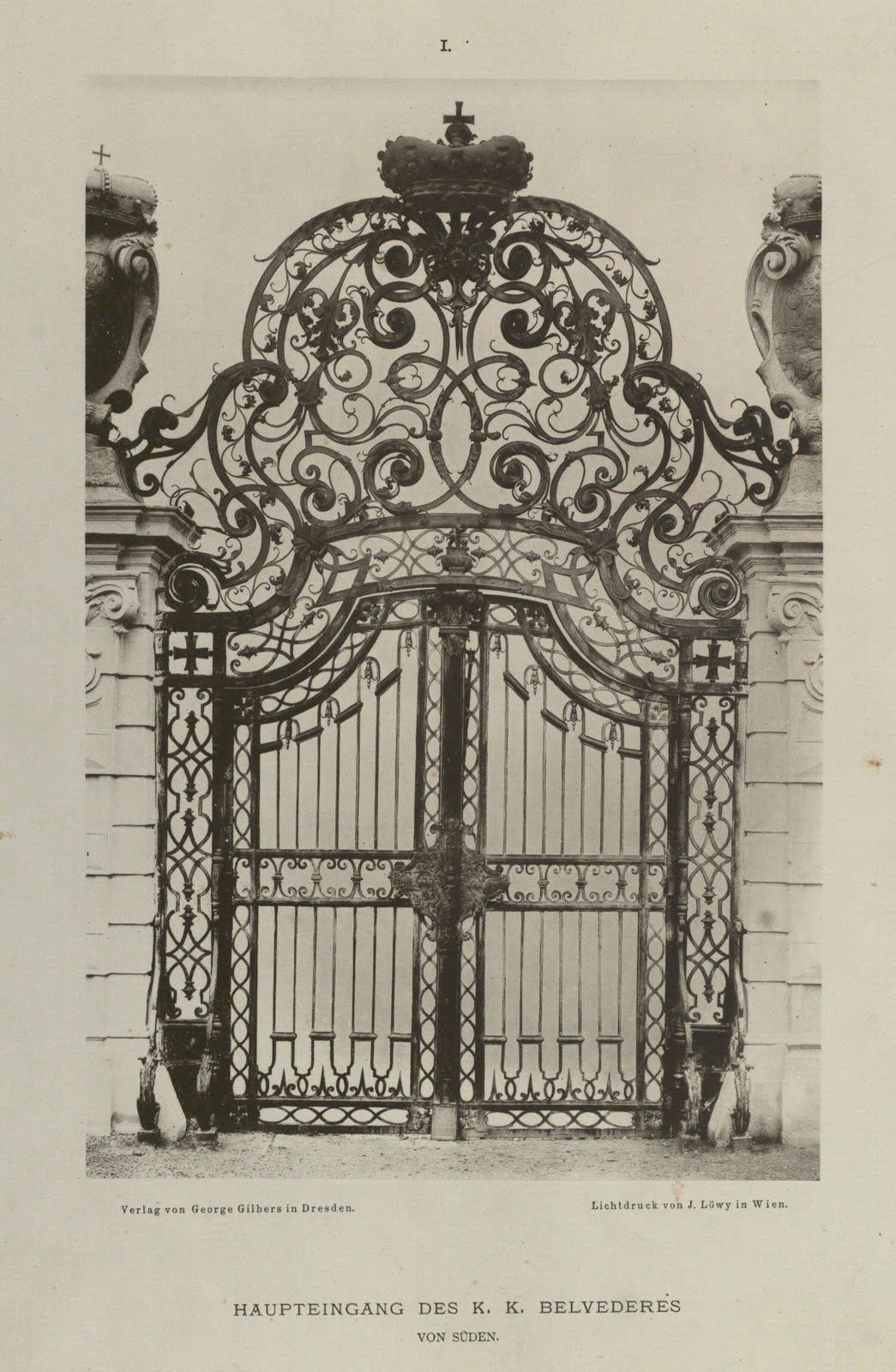
(Gate image is from a wonderful book in Special Collections on decorative ironwork in Austria, circa 1883.)

April 12, 2010

JFK's Visit to San Diego State

On June 6, 1963, President John F. Kennedy delivered San Diego State College's commencement address before approximately 30,000 people at the Aztec Bowl. He was awarded an honorary doctor of law degree during the commencement exercise at San Diego State University. It was the first honorary doctoral degree awarded by any California State University campus. Following a letter to President Kennedy in which Associated Students President Bob Weir asked him to consider giving the 1963 commencement address, California Governor Edmund Brown extended a formal invitation to the President on April 18, 1963. On May 16, a letter from Kennedy's aide Ken O'Donnell addressed to President Malcolm Love was received confirming that Kennedy would be honored to accept the honorary degree. In his commencement address he said, "As a nation, we have no deeper concern, no older commitment and no higher interest than a strong, sound and free system of education for all. In fulfilling this obligation to ourselves and our children, we provide for the future of our nation-and for the future of freedom."

Though we didn't finish in time to celebrate SDSU Month in March, we're still happy to announce a new online feature which captures an audio recording of that historic day with a selection of photographs and Daily Aztec articles documenting Kennedy's visit. (Please note: QuickTime is required to view; wait just a moment for entire feature to load before viewing.) Take a look, and perhaps revisit your own memories of Kennedy's San Diego visit!

March 29, 2010

We're on Flickr!

Thanks to the talents of our Digital Collections Librarian Lisa Lamont, the John and Jane Adams Trade Card Collection is now on Flickr!

Trade cards, also known as advertising cards, were wildly popular collectibles in the latter half of the nineteenth century as consumer culture took over America. Advertising a huge variety of manufactured goods in bright chromolithographed colors, trade cards were produced by businesses and advertisers to encourage recognition of brand names and to stimulate demand for the products advertised. Though trade cards sometimes feature rather generic Victorian images of flowers or birds, these attractive pieces of ephemera often feature comic vignettes with punchy slogans, or instructions for catchy games to be played using the card. Some are die-cut, and some have folding or moveable pieces--features that surely made great fun for their collectors. Trade cards were often issued in series to emphasize their collectible aspect, and this collection has many representatives from various series; for example, McLaughlin's Coffee "War Ship" series, or Arbuckle's "States" series.

Trade cards often contain a separate advertisement for the local seller of the product, usually on the back of the card. (In our Flickr collection, the back of the card appears after the front image in the Photostream sequence.) A huge variety of social and cultural topics are open for study using trade cards. Depictions of women and femininity, domesticity and the American home, advertising methods and consumerism, social mores, race relations, humor--all are made tangible in this wonderful type of American ephemera.

Join us (Digital Projects at SDSU Library) for fun with trade cards on Flickr! Browse through our tags, add images to your favorites list and or galleries, or leave a comment!

March 15, 2010

A New Reading Room Orientation Video

Special Collections and University Archives is pleased to announce the release of our new Reading Room orientation video, which gives a brief introduction to the department and to our policies and procedures. Geared towards all first-time users of our department, the video is an introduction to our reference desk, the registration process, materials handling basics, and procedures for making copies of materials in Special Collections. Produced in collaboration with Instructional Services Coordinator Carolyn Baber and Information Literacy Librarian Pamela Jackson, this video is the first part of a four-part instructional suite that will include future modules on identifying, finding, and analyzing primary sources in our collections. The video can currently be accessed in three ways:

Our "Using the Collections" page: http://scua.sdsu.edu/usingcoll.shtml
The Infotutor page:
http://infotutor.sdsu.edu/scua/readingroom.cfm
The SDSU Infodome Channel on YouTube:
http://www.youtube.com/user/SDSUInfodome#p/a/u/0/boZdrwlJQPY

Whether you're a first-time user or a regular visitor to our Reading Room, take a look and learn a little about the special ways of Special Collections!


February 25, 2010

Celebrate SDSU Month with the University Archives!

Discover a wealth of our university's history in our new exhibit, SDSU From A To Z. Take an alphabetical stroll through time and view photographs, yearbooks, correspondence, artifacts, and other primary sources, dating from the institution's founding as a teacher training school in 1897 to the vibrant university we know today. The selections on view will offer a glimpse into SDSU's rich and textured past using materials from University Archives collections. This exhibit is one of a number of artistic, academic, and athletic events and displays related to SDSU Month, held every year in March to celebrate our campus accomplishments and raise awareness of SDSU's vital role in San Diego's community. SDSU From A To Z is on display in the Love Library Donor Hall from March 1st through March 30th, so drop by and learn some SDSU history!

January 20, 2010

Above and Beyond: An Exhibit of Student Work in the Book Arts

Each semester, a lively and productive series of classes called The Art of the Book is offered in the Department of Art, Design, and Art History. Taught by professional artist and co-director of the Brighton Press Michele Burgess, this class is a memorable experience for all its lucky participants. In the past, students have learned binding and book arts techniques by creating one unique work for each different style of book structure. But during the 2009 Spring and Fall semesters, students went Above and Beyond the typical book arts class experience by undertaking the incredible task of "editioning" their creations. In the field of the book arts, to "edition" means to create a finite number of multiples of the same hand-printed, hand-bound book. Book artists then sell their limited editions to private collectors, libraries, and art museums. Through this assignment, students were able to operate just as professional book artists do, learning practical methods for edition binding while creatively exploring one theme in depth, and while using the full range of their artistic techniques and talents.

Students wrote their own texts using methods incorporated in "found" poetry forms. Throughout the course, there were exercises and discussions about the creative process, and about the processes used in conceptualizing and transforming ideas into paginated visual art forms. The art media and techniques used in each edition were chosen by students and adapted to editions standards, and included: hand binding, printmaking, painting, digital art and computer-generated imagery, letterpress, creative writing, metals, photography, wood and furniture techniques, ceramics and clay, drawing, sculpture, and fibers.

Special Collections is deeply appreciative of these students' willingness to donate one copy of their remarkable book creations to our collection. Stop by the gallery area outside our department (on the 4th floor of the Library Addition) starting January 25th to browse these incredible works of art!

January 6, 2010

The Peabody Magic Lantern and Glass Slide Collection


Last year, Special Collections acquired a fantastic collection of glass slides and magic lanterns, generously donated by Friends of the Library Betty and Homer Peabody. The collection contains over 2000 glass slides, and includes examples of standard, mechanical, photographic, and hand-painted slides in a wide range of topical categories ,such as medicine, education, religion, art, history, politics, travel, and popular culture. The collection also contains about 35 magic lanterns, most of which date from the late nineteenth and early twentieth centuries, and includes a particularly exciting collection of toy lanterns. In addition to these working artifacts, the Peabodys donated their collection of magic lantern literature, which includes books and serials on the history and collecting of these fascinating instruments.

Though the collection of slides and lanterns has not yet been formally processed, a significant portion of the slides has been made accessible in a truly grand online exhibit (created by our talented intern Amanda Lanthorne), which delves into the details of magic lantern use, mechanics, themes, slide types, and more using images from our collection. Take your time and explore this wonderful resource!

November 30, 2009

Viva la Huelga!: The Carmen Sandoval Fernandez Poster Collection

Special Collections is pleased to announce our newest digital collection, the Carmen Sandoval Fernandez Poster Collection. Generously donated by Carmen Sandoval Fernandez, the collection consists of 62 Chicano Movement-related posters, broadsides, and advertisements. These one-of-a-kind posters and broadsides document local events and organizations, as well as local and national groups involved in the Chicano Movement in San Diego, including the Chicano Federation of San Diego County, Movimiento Estudiantil Chicano de Aztlan, the United Farm Workers, and the Committee on Chicano Rights, Inc.

The collection dates from the early 1970s through the 1980s. Major topical themes of the posters include education, celebrations and special events, heritage and pride, conferences, demonstrations and protests, art, the Chicana movement, organizations, propaganda and slogans, fundraisers, and theater and performing arts. A brief finding aid for the collection is available in our Finding Aid Database.

The Carmen Sandoval Fernandez Poster Collection can be viewed in Luna, along with the Adams Trade Card Collection,
University Archives Photograph Collection and the WPA Murals Collection. (Be sure to turn off your pop-up blocker before viewing images in Luna.)

November 16, 2009

Greg Bear Visits His Alma Mater This Week


The Library is proud to present a lecture by award-winning science fiction author and alumnus Greg Bear on Wednesday, November 18th at 2pm in LL430. As part of the Library's ongoing celebration of Darwin anniversaries, Bear will give a lecture entitled, "What Would Darwin Do? Fundamentalism in Science and Religion Versus the Search for Scientific Truth."

Bear is a 1973 graduate of SDSU and the author of more than 30 novels and 26 short stories. He is the winner of two Hugo Awards and five Nebula Awards. His highly-acclaimed books Darwin's Radio and Darwin's Children deal with accelerated evolution and its consequences; Bear has been widely praised for his adherence to scientific fact in his crafting of science fiction. Special Collections already holds a collection of Bear's manuscripts and papers, as well as first editions of all Bear's books in our Elizabeth Chater Science Fiction Collection.

Please join us for what will surely be an exciting talk by Greg! The lecture is free and open to the public. For more information, please contact us at 619.594.6791.

November 10, 2009

Veterans at State

Veteran's Day this week warrants a look at one of our wonderful University Archives collections relating to soldier-students at San Diego State. During the early years of World War II, geography professor Lauren Post began the Aztec News Letter, a highly popular newsletter sent to Aztecs serving all over the world. Servicement and their families wrote to Dr. Post to relate news of themselves and war activities of other "Staters" they knew of. Many soldiers express, in poignant terms, their personal difficulties in dealing with combat, with suffering, with loss, and with the war atrocities they were seeing. This soldier writes in 1945, "...[I] have glimpsed some of the prison camps and talked to the inmates. The stories of Nazi atrocities are subdued rather than exaggerated and I know that you can hardly believe what has been told."

The newsletter was a critical link to their families, friends, and their lives back in San Diego,
and many soldiers express their deep appreciation of Dr. Post's efforts in their letters to him. Each issue of the News Letter is a powerful document, and each shows the huge effects of the war on both the SDSU homefront and the servicemen writing. The World War II Servicemen's Correspondence Collection is a valuable collection for anyone researching the impact of World War II on lives and families.

October 26, 2009

Darwin Lecture this Thursday

Please join us on Thursday, October 29th at 4pm in LL430 (Leon Williams Room), for a presentation by Howard Rootenberg, president of B & L Rootenberg Rare Books and Manuscripts. Mr. Rootenberg will give an entertaining look at "Darwin in the Market," and discuss Darwin, evolution, and natural selection in the world of book collecting.

Mr. Rootenberg is a member of the Antiquarian Booksellers Association of American, the Bibliographical Society of America, and the Grolier Club. He actively researches and lectures on rare books and the history of science and medicine, and has been kind enough to loan several items for the exhibit currently on display in Special Collections, The Book that Shook the World. Please join us in welcoming him on Thursday!


Portrait of Charles Darwin on display in Special Collections, on loan from Barbara Rootenberg.

October 5, 2009

Socialist Sources

Special Collections has recently uncovered an unusual item in the San Diego Vertical Files Collection: a minute book for a socialist organization in San Diego County from 1913-1916. These handwritten minutes records the organization's activities and accounts during these years. Though the full name of the organization is not recorded, the minutes show support for various national and local socialist and labor concerns (including the large 1913 Wheatland hop-picker strike in California). The group was apparently anti-Anarchist in their leanings, as they decided not to subscribe to the International Socialist Review because of its contributions by Anarchists; however, they did subscribe to periodicals like The American Socialist and Western Comrade. According to membership rolls in the book, local women were active in the chapter, and one, Anna Willoughby, was chair for some time. Debates, readings, speeches, and even musical entertainment were part of these rousing meetings.

The minute book makes an important contribution to our understanding of the labor movement in southern California during the Progressive era, especially after the San Diego "free speech fight" of 1912. These riots occurred when the city passed an ordinance prohibiting free speech at the soapbox corner of 5th and E Streets, where the local IWW chapter frequently recruited. Many local labor leaders disobeyed, and over 5,000 others arrived in San Diego from around the nation to demonstrate against the ordinance. As a vigilante crew attempted to subdue them, violence broke out, and many workers were jailed for some months. Well-known anarchist Emma Goldman even arrived in San Diego to show solidarity with the demonstrators, but left almost as soon as she arrived when vigilantes threatened her and her agent. The San Diego Historical Society has fascinating photographs of these demonstrations, and San Diego State has other very important sources (see under G., Business) that can be used to research labor history in the area.

August 28, 2009

Welcome Back!

Special Collections and University Archives welcomes students, staff, and faculty back to campus for Fall 2009. Special Collections is, quite simply, the coolest place on campus! We are home to over 60,000 rare books, over 500 manuscript and archival collections, and half a million other items like photographs, postcards, prints, and ephemera. We are also the home of the San Diego State University Archives. Special Collections is your first stop to discover amazing primary sources on the history of San Diego and dozens of other subjects. Stop by our website to explore our holdings using the Finding Aid Database and the Library's Catalog, then stop in our Reading Room to experience the materials hands-on and up-close. Don't know what you need to see? Stop in to consult with one of our librarians, and we'll match you with the collections best for your research.

Fall 2009 is shaping up to be an interesting semester, in Special Collections, in the Library, and around the whole campus. Due to CSU budget cuts and resulting faculty furloughs, we will sadly be limiting our available instruction sessions and reducing our hours in the Reading Room. Our new schedule is: Mondays and Tuesdays, 12pm to 7pm; Wednesdays, Thursdays, and Fridays 10am to 3pm. We will also be closed every other Friday: September 11 and 25, October 9 and 23, and November 6 and 20. Please check our website for these hours, and check out the Library's schedule for hours changes throughout the Library.

We invite you to view several unique exhibits throughout the Library celebrating the life, works, and influence of Charles Darwin. These will be on display through the end of the semester--stay tuned for announcements about our accompanying lecture series!

(Images are from the University Archives Photograph Collection, and show a 1992 campus rally protesting drastic SDSU budget cuts, and the student signs and posters put up in protest on the entrance to the Administration Building that year. There is an all-campus rally against the current drastic budget cuts on the first day of classes, August 31 at 11:30am in front of Hepner Hall.)

August 10, 2009

Celebrating Darwin's Life and Work

Library and Information Access is hosting several exhibits during Fall 2009 in honor of Charles Darwin's 200th birthday and the 150th anniversary of the publication of On the Origin of Species. In the Donor Hall, you'll find Darwin Now, a traveling exhibit created by the British Council that explores Darwin's life and the importance of the theory of evolution to the contemporary world and to modern science. Biological specimens from the collections of the SDSU Department of Evolutionary Biology (including a Galapagos Island tortoise shell and a terrarium of orchids and insectivorous plants) are also on display in the Donor Hall in an exhibit called The Fact of Evolution. Special Collections will host the exhibit The Book that Shook the World, a vivid exploration of Darwin's life, his masterpiece, and his other contributions to scientific thought using illustrations, photographs, and first editions of his works. A complementary display called Discovering Darwin highlights evolutionary thought in books and ephemera from the collections of Special Collections. These exhibits begin on August 10th and will run through December 20th, 2009. Stay tuned for details about lectures and other events in conjunction with these terrific exhibits!

(Image: the rare orchid Angraecum sesquipedale, which Darwin studied intensively.)

July 1, 2009

Online Archive of California (OAC)


Special Collections and University Archives is pleased to announce that the Online Archive of California (OAC), a core component of the California Digital Library (CDL), now includes finding aids for all of our processed collections: http://www.oac.cdlib.org/institutions/San+Diego+State+University.

The OAC provides free public access to detailed descriptions of manuscript and archival collections maintained by more than 150 contributing institutions throughout California. As California's central repository for collection guides, the OAC is a vital resource that serves everyone interested in California's rich history, allowing them to browse online, search for information about specific items and their location, and learn how to access them no matter where in the state they are housed.

Our contributions have especially enriched the OAC's holdings documenting the San Diego region, and will enable all OAC users to discover our collections. Additional collections are added on a continuing basis.